If you are considering building an LS engine or LT engine for your project car, engine swap, racecar, etc, your first step is going to be deciding what block you want. LS/LT engines come in a range of sizes from the factory from 4.8L to 7.0L. The smaller displacement blocks and the iron blocks tend to be cheaper, with the aluminum 7.0L LS7 blocks commanding the highest premium of the OEM options. There are also several aftermarket LS/LT engine blocks available such as the Summit Pro LS 7.0L, the LSX454, the LSR, and the LTR to name a few. Aftermarket blocks typically have the benefit of being among the bigger displacement sizes (typically 6.2L and up), with stronger castings, improved main caps, and sometimes priority main oiling. However, as expected these blocks are going to be significantly more expensive, triple to quadruple the cost of an OEM block. But what if you could have your cake and eat it too? What if you could take a block as small as a 5.3L and turn it into a 7.0L - one that has stronger and better sleeves than any factory block? That is where resleeving your LS or LT block comes into play.
Do factory ls blocks have issues?
You bet they do, we’ll start with the most problematic part of factory blocks - core shift. Let’s start by explaining how LS engines are produced. The factory that casts the block obtains the “sleeves”(the individual cylinder bores that a piston travels up and down in) and using a fixture they hold those sleeves in place as the aluminum block is cast around the iron sleeves, which are ribbed to help form strong bonds to the aluminum. Unfortunately their fixturing wasn’t great, because anyone who has ever cut factory sleeves out of a block has seen how crooked those things are. The sleeves sometimes point in different directions and because of that the factory blocks, especially the LS3s, experience something called “core shift”. Below is a photo showing what we typically find when we cut out factory sleeves, you can see where the ribs of the sleeve didn’t fully clean up on the right hand side of the bore. On the left hand side they fully cut out, this is indicative of crookedness in the sleeve fixturing during casting. The second image below shows the deck surface of an LS3. You can clearly see the left band of iron that is the sleeve is much thinner than the band of iron on the right, this is core shift. Core shift is nasty to combat when you attempt to overbore a block even .005 or .010 over standard bore size. If your block has extreme coreshift, you can easily create a time bomb of an engine by trying to take it oversize, which is shown in the third photo. In the case of the third photo the sleeve was so obscenely thin in the middle of the bore that you could push on this crack with your thumb and flex the sleeve.
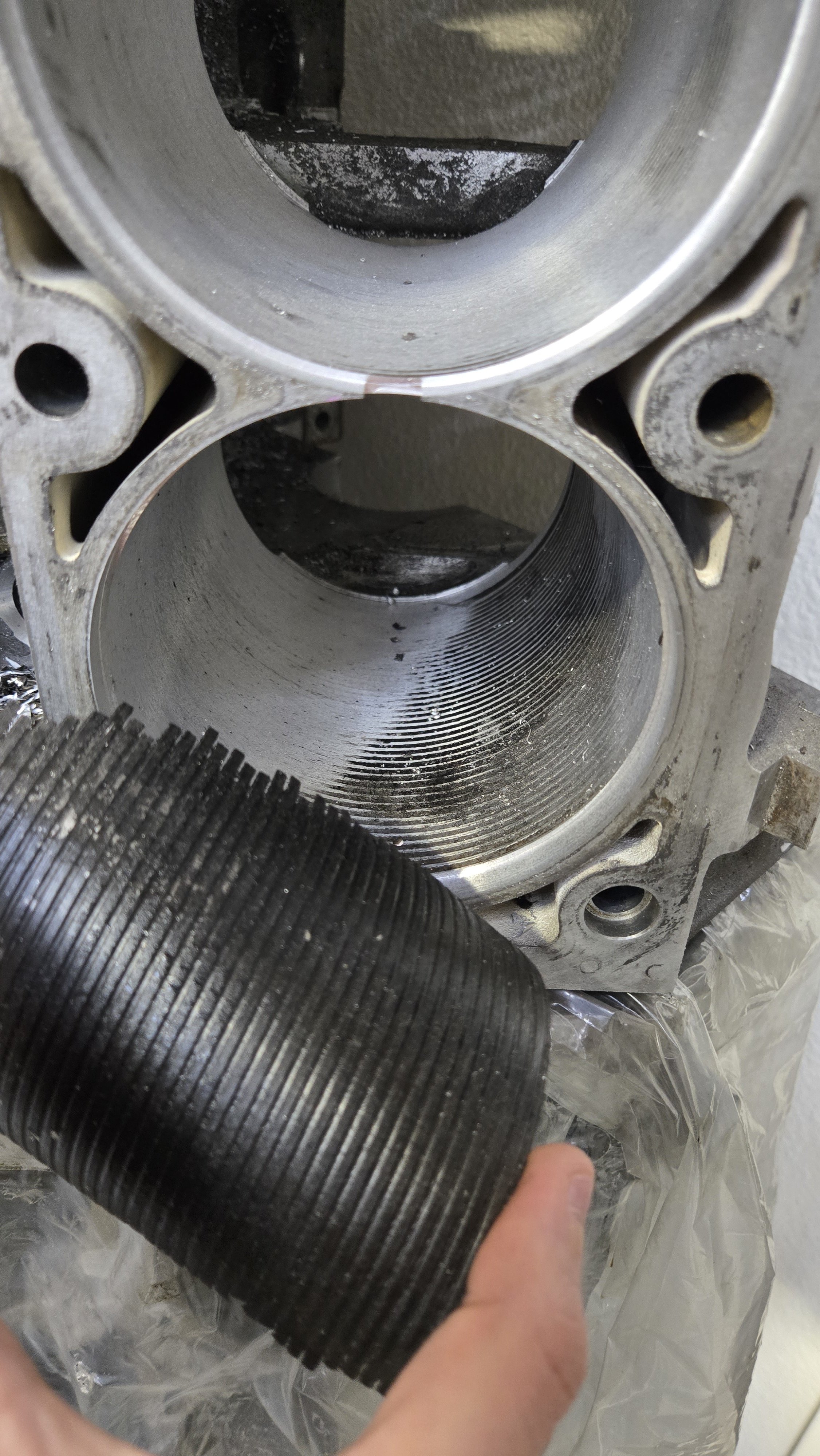
Example of sleeves not being installed straight on an LS3
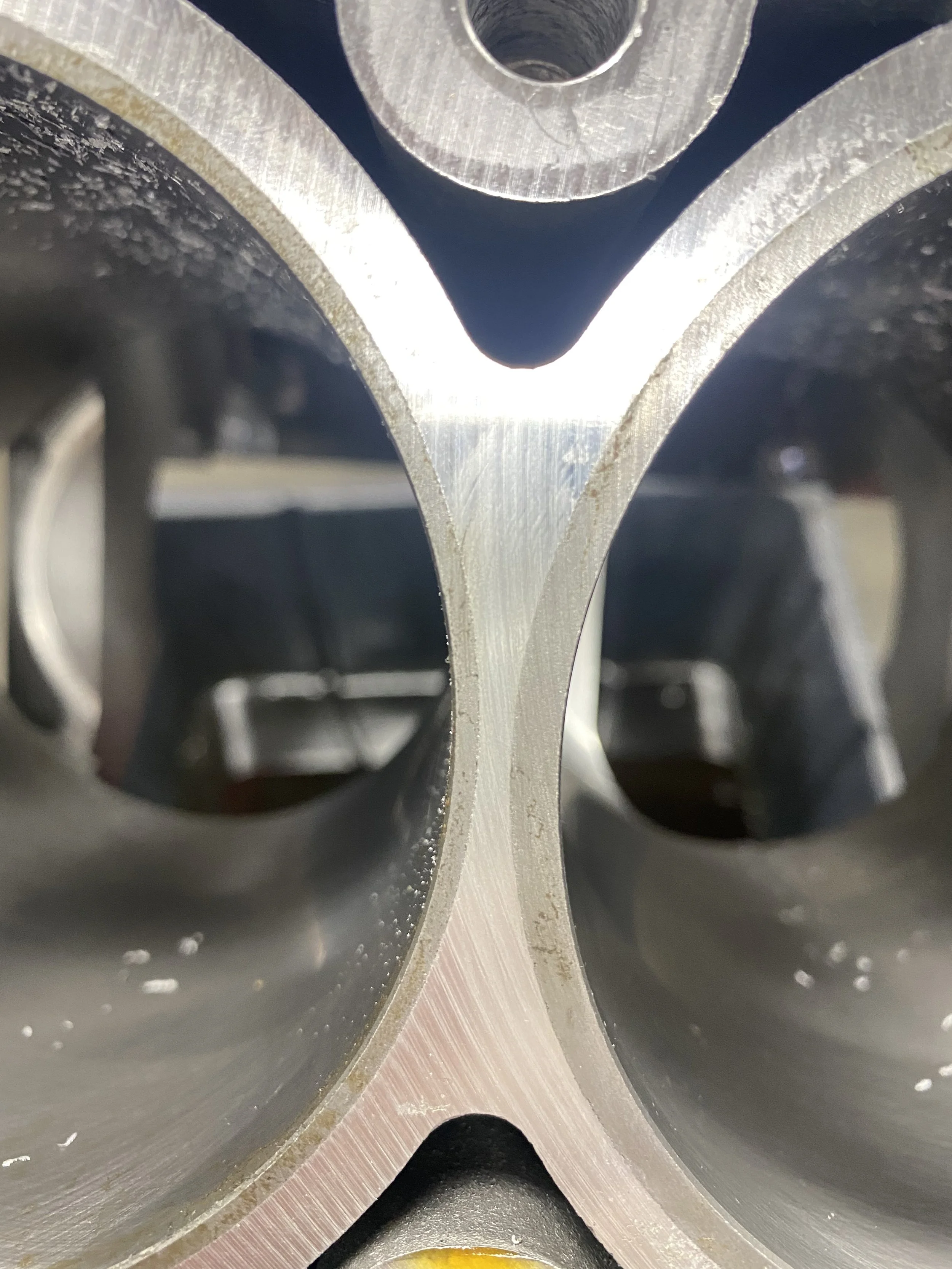
Example of core shift on an LS3
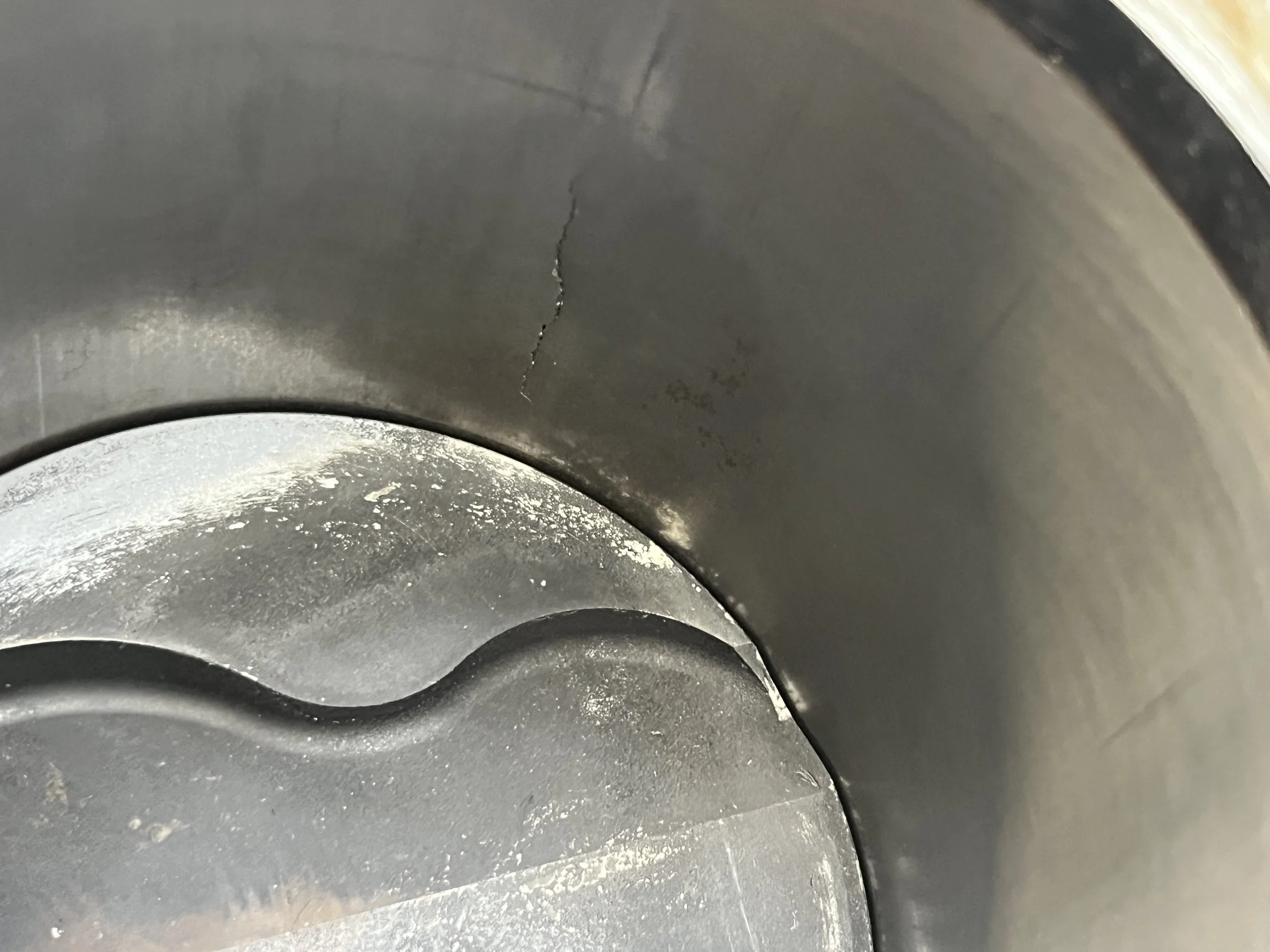
Example of thinness in sleeves that were overbored and crooked
Now, if core shift wasn’t enough of a problem on its own (though again, this is mostly something that is common with LS3 engines) the factory blocks have a few other issues worth noting.
Sleeve Thickness - Okay, this is not a problem most 5.3 blocks have. Let’s get that out of the way. This is also less of a problem with the aluminum LS2 blocks. Cylinder wall thickness is a BIG issue with iron 6.0s (which don’t have sleeves, the cylinder wall is the block itself, but you read that right and I’m looking at those guys that keep boring iron 6.0Ls out to 6.2Ls congratulations you have a bomb), with aluminum 6.2s, and especially with the king of cylinder issues itself, the almighty LS7.
Iron 6.0L blocks have a ranging cylinder wall thickness of around .300* on the thrust surface - the areas where the piston skirt travels *(some are thicker some are thinner) but on the pin side, i.e the side that is closest to the other cylinder, we have seen thickness as little as .085 in a standard bore application. This is because they aren’t “siamese bore” blocks, there is coolant between the cylinder walls. So, when folks bore these things from standard bore of 4.000 (6.0L) to 4.065 (6.2L) they are removing .0325 per side, leaving only about .050 of cylinder wall left. The minimum acceptable cylinder wall thickness for a high performance engine is usually cited at .100, for boosted or nitrous engines the spec is cited at .125 and up, more is better. When you have such little cylinder wall remaining your bores can deflect (move, crack, etc) while the engine is running, leading to excessive oil consumption, lack of ring seal, and loss of power or complete failure. Many people run their iron 6.0Ls at 6.2L bore size, some boosted, but the truth of the matter is that the extra .065 displacement is not worth the instability of the block, the lack of rebuild-ability in the future, and the risk of complete failure.
Aluminum 6.2Ls; the LS3s, LSAs, and the LS9s, have a sleeve thickness of .070-.100 overall, anywhere on the sleeve, depending on the amount of core shift. Let’s say you have a standard bore (4.065) LS3 with core shift, and you try to go .020 over. You are now at 4.085, and your sleeves could be as thin as .060. For this reason the maximum overbore that we do here at Flag on factory LS3 blocks is typically .010. That likely gives you two rebuilds, one at .005 and one at .010 over, but tries to keep as much material available as possible. For customers who want to boost their LS3 blocks, we highly recommend sleeving them for longevity and durability.
Aluminum 7.0Ls, the infamous LS7s - when they don’t fail from a valve dropping and exploding a piston which sets the connecting rod loose to punch through the block like Jack Nicholson in The Shining, they fail from the coating coming off of the Ti rods which gall together, or my personal favorite the ole “cracked a sleeve just from existing”. LS7s are the only factory GM block that was not cast around the sleeves, the blocks were cast and then machined and sleeves were installed. For this reason, LS7s don’t suffer from core shift. What they do suffer from is stupidly thin sleeves, which can easily be perfectly measured because you can press the factory sleeves out of an LS7 block. We did so, measured, and found that a factory LS7 sleeve is .085 thick at standard bore. The max overbore we’ll do on LS7s is .010 over (4.135) because any further than that and we have documented cases of sleeves flexing under operation. This presents as cars that fill catch cans quickly, overheat intermittently, and don’t make the power they should due to lack of ring seal. Overall, LS7 owners live a very rough life and most have been traumatized with at least one engine failure. If you own a C6 Z06 and have been personally victimized by valve drop, I can only sympathize and direct you to drowning your sorrows by blasting Creed in your non-running car.
Sleeve Length - Let’s say you have an iron 6.0L (sorry 6.0L fans, I’m coming after you guys in this article) and you want to run a stroker kit. Normal LS crankshaft stroke is 3.622, but you want that 4” stroke to make more torque, and you install it in your freshly honed 6.0L. You may notice that your pistons come about 3/4” out of the bottom of the cylinder as you spin the engine over, leaving that width of skirt unsupported as it rotates. Factory LS sleeves range from 5.400 at the shortest all the way to 5.900 in the LS7s, which run a 4” stroke crank from the factory and have the sleeve length to support it. LS7 blocks have other drawbacks, some mentioned above, but otherwise sleeve length is a chronic issue across the OEM blocks for stroker crankshafts.
Sleeve Material - OEM LS sleeves are made of grey cast iron, which was chosen because it was cheap, not because it was good. This material is brittle, and it isn’t resistant to flexing. In a stock application it is more than fine, but when you build a high horsepower performance engine, you start to see the problems. We experience this first hand when honing blocks on our Rottler H85A if we try to hone an LS block without a torque plate. The pressue of the hone head itself will flex the sleeves outwards and deform the bores, which is why we always use a torque plate. With LS7s, we can run into issues at the bottom of the sleeves where they have the least support from the block even when a torque plate is trying to hold the top together.
what is resleeving a block and how is a sleeved block better?
When we resleeve a factory block we load it onto our 4 axis block work CNC machine and probe the block to blueprint it. From there, we probe the exact spot the sleeves “should” be in, if the factory sleeves were correct, and we begin cutting out the old sleeve. The CNC machine cuts the bores straight and true, and cuts them oversized to accomodate the new sleeves we’ll be installing - which are of course, thicker, stronger, and longer. After the old sleeves are cut out and the bigger bore is cut for the new sleeves, our program cuts the counterbores for the flange of the new sleeves to sit on. All of this has to be done on an extremely precise machine, with highly accurate measurements to ensure proper sleeve fitment. Once everything is cleaned, we can install the new sleeves into the block. Flag Motorsports offers two options for sleeves: a 6.2L size replacement sleeve that is made of ductile iron vs cast iron and is 5.700 length to support a stroker crank, and the famed Darton big bore 7.0L+ displacement 5.800 length even stronger ductile iron sleeves.
Sleeving itself solves the possibility of core shift because the bore is cut where it needs to be according to the CNC blueprinting of the block, so the sleeves are installed perfectly straight no matter what.
The sleeve thickness increases with aftermarket sleeves, the 6.2L replacement sleeves are .118 everywhere at standard LS3 bore with zero core shift. The Darton sleeves are .0925 at standard LS7 bore size.
The sleeves are longer than factory to support stroker cranks, going from 5.400 to 5.700 or 5.800 to eliminate pistons coming out of the bore.
Lastly, the material of the aftermarket sleeves is so significantly stronger that it resists deflecting and eliminates concerns of bore “breathing” even at .068 thickness (we have a certain 455 LT road race Camaro out there proving this every day).
Why should I get a sleeved factory block instead of an aftermarket block?
There are use cases for both options. Resleeved factory blocks really shine when you have your existing engine block and you want to correct bore geometry, make more power reliably, and want to save money. A sleeved OEM block costs $2,500 with full machine work for the street sleeves we do, and $4,100 with full machine work for a Darton sleeved big cubic inch monster. In contrast, an LSR/LTR block is about $7,000 before any machine work. Machine work to those isn’t cheap either, because they ship with very undersized mains that require significant align honing, they are very undersized on the bores and require a bore/hone, and they require a surface because the deck is .011 high. That means almost $1,000 on top of the cost of the block in machine work alone. We have also run into issues with aftermarket blocks when it comes to casting defects, sleeves dropping, pressure failures, threads not fully cut, lifter bore clearance issues, and casting contamination. Essentially, aftermarket blocks have their own slew of problems and when you buy them new they’ve never been run and proven. Reusing and resleeving a “seasoned” OEM block that has been heat cycled and proven gives our clients a lot of peace of mind.
That said, if you want to go make 2,000+ horsepower you’re going to need the improved strength and structure that an aftermarket block has. At a certain point you’re going to need a billet block to be a real bad mamajama. We’ve proven the sleeved factory blocks up to the mid 1000s in horsepower (about 1,500ish) and haven’t had one blow apart the casting yet, but aftermarket blocks will take the cake in a race to make the most horsepower up over 2,000.
It is my hope that this article helped inform and educate you about the pit falls of the factory LS and LT blocks, and the upsides to resleeving them. If you are in the market for a sleeved block, or considering one for your engine build check out our Sleeving page for more information or give us a call to discuss. If you have any questions that we didn’t address in this article, drop us a line via our Contact page and we’ll get back to you - and maybe even include the answer in the article itself.
This article is fully written by a human. My English teachers taught me to use em dashes, and now I can’t stop. Blame them, not me.