What is the Best LT4 Camshaft? 2026 Gen 5 LT4 Camshaft Shootout
What is the Gen 5 LT4 Camshaft Shootout?
Welcome to the 2026 LT4 Camshaft Shootout, brought to you by Griffin Motorsports and Flag Motorsports! This shootout is an engine dyno test of LT4 PD blower camshafts, back to back, in an A/B comparison using a stock LT5 camshaft as a baseline. Our goal is to share all of this LT dyno data with the community, and to help further develop camshaft profiles for the LT4 that may be missing from the current market. We believe this information will be invaluable for owners of LT4 engines/vehicles, and for performance shops to be able to recommend the best parts for their clients. It is also our hope that this test inspires others to performance LT engine testing as well!
Information and documentation surrounding the Chevrolet Gen 5 LT engine platform is difficult to find, and often shrouded in much secrecy. There is a much more limited number of companies who build Gen 5 LT engines and make parts for this platform as opposed to the LS engine architecture. The LT was introduced in 2014, but 12 years later in 2026 there is still a lack of test-driven data available for them. To that end, Gabe at Griffin Motorsports and the team here at Flag Motorsports decided it was time to end the mystery.
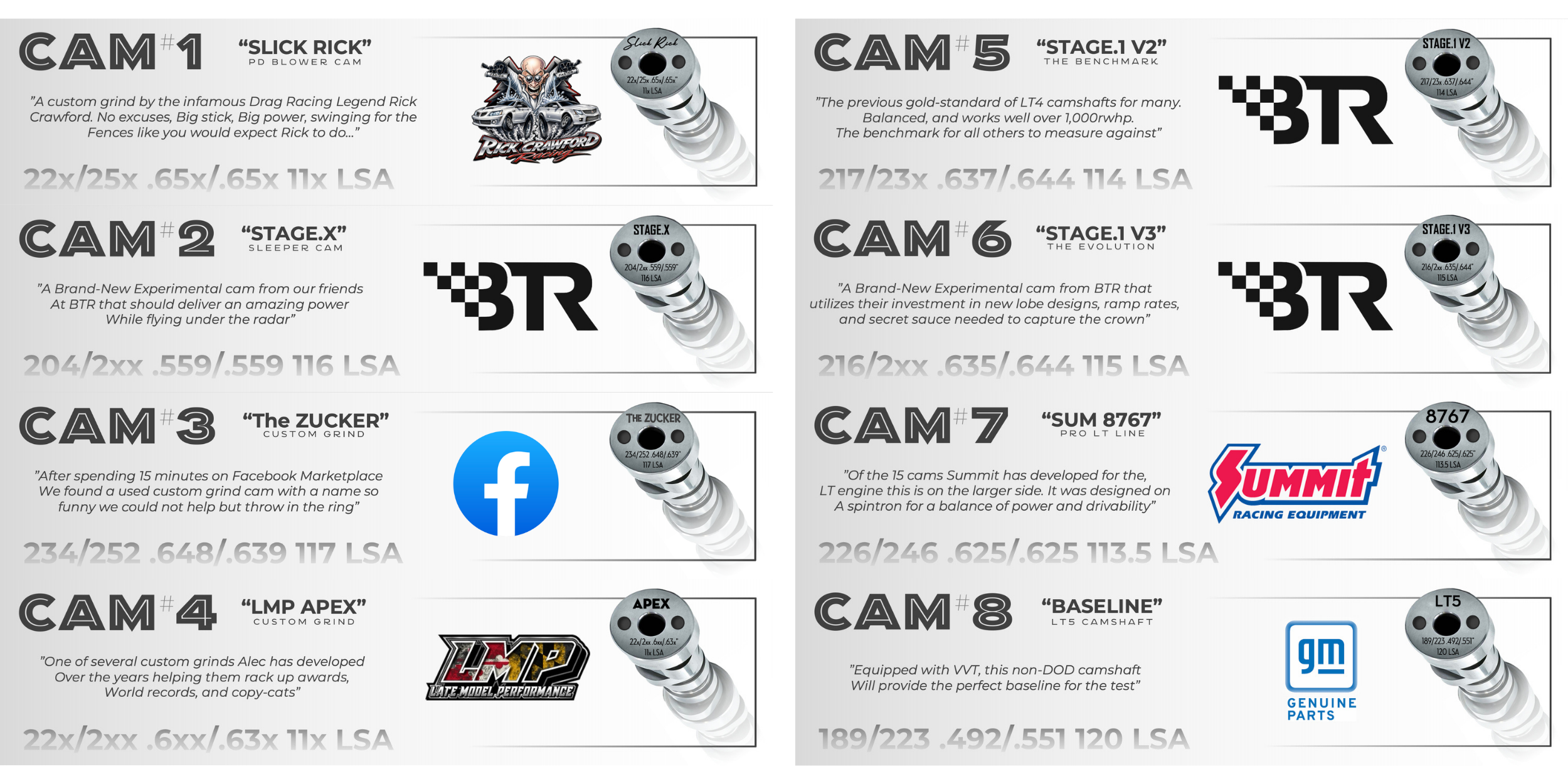
On August 17th-21st, 2026, we are testing eight LT4 camshafts in a five day dyno challenge at Westech Performance in SoCal. Here are the contenders:
What does the test include?
Camshafts aren’t the only thing we’re testing though! This test also features:
- a blower comparison between the stock 1.7L LT4 blower, a Kong ported LT4 blower, and then a 3.0L Whipple supercharger.
- a throttle body comparison between the LT4 factory throttle body, and then the Katech ported 103mm throttle body.
- a cylinder head comparison between factory LT4 heads and Flag Motorsports ported Mach V cylinder heads
This allows our test to be one of the most comprehensive and technically detailed camshaft tests for the Gen 5 LT4 engine, with the most current and modern data available. None of this extensive testing would be possible without the amazing support of the sponsors who stepped up to help us execute this test. We are extremely grateful to have the generosity of these companies, and to be able to feature their parts throughout the test.
Our Sponsors
Summit Racing: Camshaft + LS/LT connecting rods + coated bearings + pushrods
CP Carrillo: Forged LT4 pistons with .230 wrist pins
Renegade Fuels: 110 gallons of RM 109 race fuel + multiple cases of oil
ATI Performance: 6 bolt upgraded hub harmonic damper
Brian Tooley Racing: LT valves + valve springs + rocker arms
Whipple: 3.0L Supercharger + 112mm TB + 12 Rib Pulley
Smoothboost: Drive-by-wire supercharger boost controller kit
Dyme Racing: Quick connect various fittings and hoses
GripTec: 12 rib upper pulley's for the 1.7L
Brisk Racing: Multiple sets of spark plugs
Bonefied Tools: Hydraulic harmonic balancer remover/reinstall tool
XDI: Goliath LT4 high pressure fuel pump + 50+ LT4 fuel injectors
Katech: Billet front and valley covers + C5R Chain + wet sump billet oil pump + 103mm throttle body + 112mm throttle body
TooHighPSI: 12-rib + billet supercharger lid + billet valve covers + billet thermostat
Kong Performance: X-port 1.7L LT4 supercharger
ARP: 12-point and superior custom hardware for every cover on the engine + balancer bolt
CSF Racing: Intercooler bricks for the 1.7L factory LT4 blower
Granatelli Motorsports: Ignition coils + spark plug wires
Operational Speed Supply: Multiple sets of LT4 cylinder head gaskets
JLT Performance: Cold air intake
What is the testing sequence?
Our team has 5 straight days on the engine dyno at Westech, with 8-9 hours a day of working time. We have eight camshafts, three blowers, two throttle bodies, and two sets of cylinder heads to compare and contrast. In order to be efficient and make the most of our time, we’ve made sure that our approach gives us the A/B data we’re looking for while also making sure we can accomplish all of our testing. Here’s a breakdown of each day.
Day 1
-Establish OEM baseline with stock LT5 camshaft (camshaft #1), stock 1.7L blower, and stock throttle body.
Day 2
-Lower pulley change from 8.8 inch to 10 inch
-Change to camshaft #2 and test
Day 3
-A/B test stock LT4 heads to Flag ported LT cylinder heads on camshaft #2, stock blower
-A/B test stock LT4 blower to Kong X-port blower with 103mm throttle body on camshaft #2, stock heads and ported heads
Day 4
-Camshaft #2-7 test all in one day to ensure accuracy of temps and eliminate variables
Day 5
-Change blower with Whipple 3.0L and Katech 112mm throttle body for glory run with the best suited camshaft.
-Pack up our toys and head home!
LT4 Camshaft Contenders
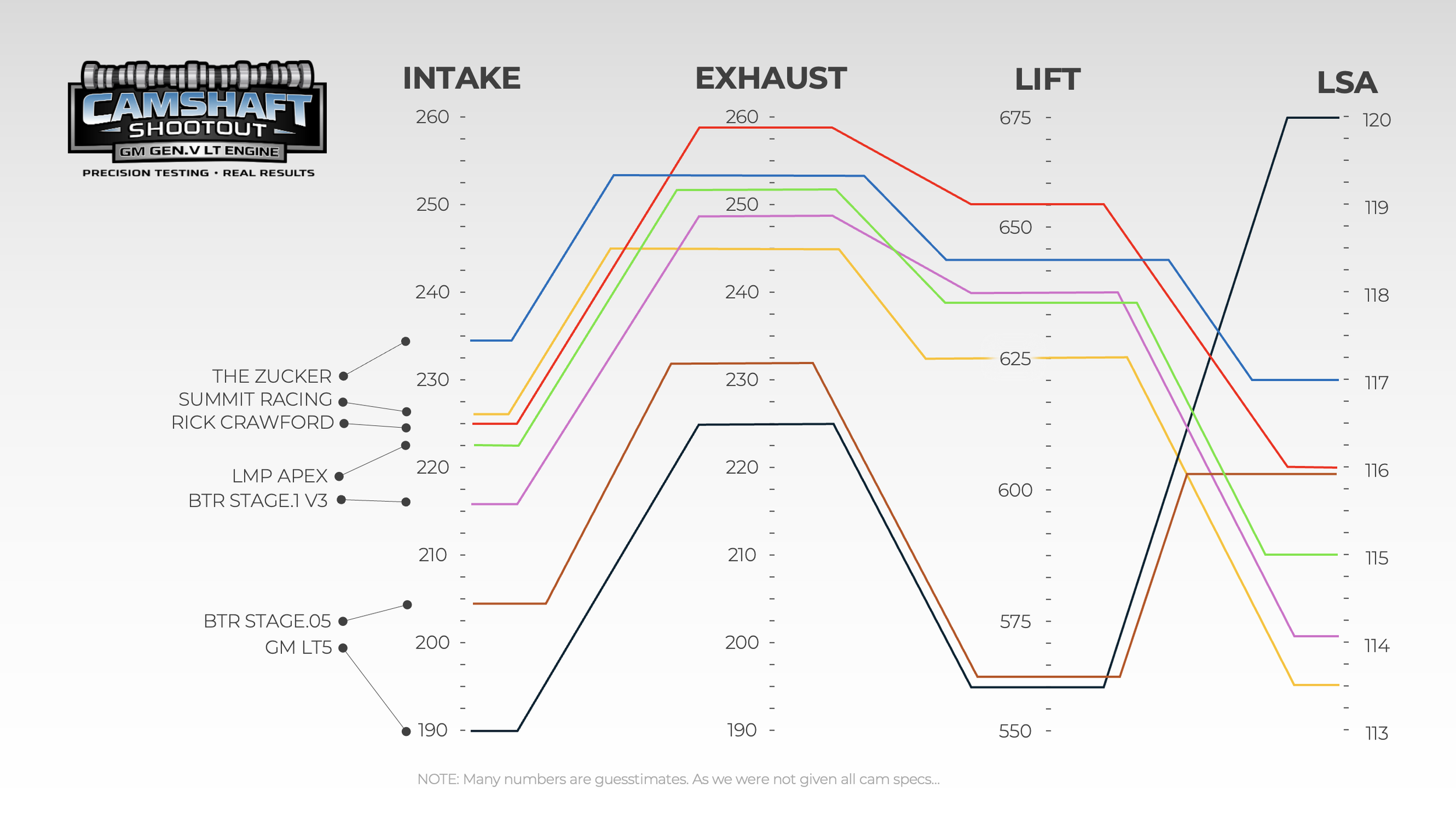
The below chart provides a visual graph of the range of camshaft specs we are covering in our test. For custom camshafts like Rick Crawford’s and LMP’s, we were not provided all of their cam specs so some of the chart is a guesstimate. Camshaft specs are frequently protected by companies as years of personal experience, knowledge, and testing goes into a designer’s camshaft philosophy and many designers want to protect their hard work. We believe in education and transparency in the automotive world, but also respect the designers who chose to protect their specifications. For that reason their exact cam specs are unknown to all but the designers themselves, and will remain that way. We will discuss the testing by making assumptions based off of the specifications they do share, and the dyno data itself.
The Engine
The LT4 used in testing for this camshaft shootout was built by us here at Flag Motorsports with the amazing sponsorship of internal parts from companies like Summit Racing, CP Carrillo, BTR, Katech, and ARP. The block is originally a 5.3L L83 block that was sleeved in house here at Flag up to a 6.2L. The mains were align honed with ARP studs. This shortblock features a forged crankshaft, Summit Pro LT forged connecting rods, CP Carrillo forged pistons with wrist pin upgrade, and Summit’s coated race bearings. Katech sent us their wet sump billet LT oil pump and viton chain guide, along with their modified cam gear and C5R timing chain. We are also using the Katech billet front and valley cover to seal up the engine. The engine’s airflow is through the Flag Motorsports Mach line of cylinder heads for the LTs, featuring 5-axis CNC ported intake and exhaust runners and a valve job cut in house on our Rottler SG9. We drill LT1 head cores for the supercharger bolt pattern, upgrade guides to bronze, and upgrade seats to correct the LT1 seat issue with high lift cams. The heads are loaded with valves and springs provided by BTR, who also sent their trunnion upgrade rocker arms and pushrods. ARP head studs and bolts for all covers and dressing help fully secure and decorate the engine. ATI provided their hardened hub, dual keyway 6 bolt damper to accept the TooHighPSI 10” 12-rib lower pulley that is part of their full 12 rib Reaper kit. TooHighPSI also sent us the billet valve covers and LT4 blower lid to fully decorate the engine, and ensure that it looks as good as it will perform. We could not be more excited to see this engine run on the dyno and learn about what it will make and what camshaft will “win”! Special thanks to Jorge at Top Gun Performance Tuning for flying out for a week to make sure our LT4 engine was safely tuned and making great power!

Our esteemed location for the LT4 Camshaft challenge

Filmed and featured in Hot Rod Magazine
Technical Information
1.7L Positive Displacement Blower Design
Factory LT4 engines have a very small 1.7L positive displacement or “PD” blower that spins at 21,440 RPM when the engine is at 6,700 RPM. This differs wildly from other blower designs such as centrifugal that spins much faster, or a large displacement supercharger that spins significantly slower. The value in the 1.7L is that they are much less “vampiric” meaning they take less power from the engine to spin, and are more efficient while producing less heat. The PD blower design uses teflon coated rotors to form a seal as they spin that forces air down into the combustion chamber, they aren’t effected by backpressure or system resistance. Centrigual design relies on an impeller that builds up the speed of the air and pushes it towards the intake manifold of the engine. However, this design is weak against system resistance and vulnerable to pressure differentials. Think of a fan blowing air; if something stands in front of the fan, the airflow is significantly reduced. This is centrifugal blower design. PD blower design is more equivalent to an air compressor, that air is being trapped and compressed and forced out no matter what. The difference of design with PD blowers is important to understand, because it plays into the camshaft design requirements. Designing a camshaft for a PD blower is a much different ball game vs designing a cam for an NA engine, or for engines utilizing other types of blowers/turbos/etc.
Direct Injection vs Port Injection
The last aspect to consider with the LT4 is that it is a direct injection engine. This is one of the features that differentiates the Gen 5 LT architecture from the Gen 3 and Gen 4 LS engine architecture. Direct injection is a system that delivers highly pressurized fuel directly into the combustion chamber, for the LT4 this means the injectors operate at 2,900psi. Port injection releases fuel into the air stream that travels down the intake runner of the cylinder head before being burned in the combustion chamber, typically at about 58psi. The psi differential is one consideration but what most don’t consider is that because the fuel is being injected directly into the combustion chamber, it doesn’t take up any space in the airflow coming into the cylinder head’s intake runner. On a port injection engine roughly 8.5% of the CFM volume of the cylinder head’s intake flow is taken up by fuel. A DI engine does not have that, meaning there is no 8.5% CFM loss and that a DI cylinder head is strictly flowing air. These two factors have a huge implication when it comes to designing a camshaft for a DI engine.